AI adoption should operate as a discipline

Organizations rarely struggle because they lack AI ideas. The harder problem is turning those ideas into governed, operationally useful capabilities that the business can trust, adopt, and measure.

FUSE™ is designed to address three common breakdowns: promising use cases that never reach production, governance and risk controls that arrive too late, and weak connections between AI investment and measurable business outcomes.

Instead of treating strategy, governance, implementation, and measurement as separate efforts, FUSE™ keeps decisions, assumptions, ownership, controls, and business outcomes visible as work moves forward.

The FUSE™ AI lifecycle

Four phases move AI from opportunity to measurable business value

The primary path moves from F through E, but organizations do not complete one phase, put it away, and start the next from scratch. Supporting workstreams begin early, mature as the initiative develops, and remain visible throughout the lifecycle.

FUSE AI Framework cycle showing Foresee, Unify, Systemize and Secure, and Evaluate

FUSE™ has phases, but it is not a waterfall. Governance, data readiness, security, change and adoption, and value measurement begin early and mature across the lifecycle.

F
Phase 1

Foresee and Define

Foresee and Define establishes why the organization is pursuing AI and where it should focus first.

This phase connects AI ambition to business priorities. Teams identify potential opportunities, evaluate where AI can create meaningful value, define the business outcomes that matter, and establish the measures that will later determine whether an initiative succeeded.

Typical activities

  • Clarify AI objectives and business priorities
  • Identify and organize potential AI use cases
  • Assess business value, feasibility, risk, and readiness
  • Prioritize which opportunities deserve investment
  • Define success measures and baseline metrics
  • Identify early governance, data, security, and adoption requirements
U
Phase 2

Unify and Align

Unify and Align turns a prioritized opportunity into something the organization can actually execute.

The objective is alignment across the people, processes, data, technology, governance, and operating responsibilities required to make the initiative viable.

Typical activities

  • Align executive, business, technology, governance, and operational stakeholders
  • Define how the future workflow should operate
  • Clarify data and system requirements
  • Identify ownership and decision rights
  • Refine governance and human-oversight requirements
  • Identify dependencies, assumptions, and blockers
  • Translate the opportunity into an implementation-ready design
S
Phase 3

Systemize, Secure, and Scale

Systemize, Secure, and Scale moves the initiative into real business operation.

This is where designs become working capabilities embedded into workflows and systems. Governance, security, cost control, human oversight, operating responsibility, and scalability are treated as part of implementation rather than tasks to address after the technology works.

Typical activities

  • Configure or build the required capability
  • Integrate the capability into existing workflows and systems
  • Implement governance and approval controls
  • Validate security, privacy, and access requirements
  • Establish human oversight
  • Prepare users and operating teams
  • Test performance and business readiness
  • Establish patterns that can support future scaling
E
Phase 4

Evaluate and Evolve

Evaluate and Evolve determines whether the initiative is producing the value it was intended to create and what should happen next.

AI implementation should not end when a capability goes live. Organizations need to compare actual performance with the baselines and targets established earlier, understand adoption, identify risks or weaknesses, and decide whether to refine, expand, pause, or retire the capability.

Typical activities

  • Measure performance against business KPIs
  • Compare actual results with baselines and targets
  • Evaluate adoption and workflow effectiveness
  • Review governance, control, and operational performance
  • Refine capabilities based on evidence
  • Identify opportunities for responsible expansion
  • Retire initiatives that are not producing sufficient value
01

Governance does not belong in a single phase

Governance, security, data readiness, human oversight, change management, and value measurement begin early and become more specific as the work matures.

  • A governance concern identified during Foresee can become a formal control during Systemize.
  • A data limitation found early can become a readiness requirement during Unify.
  • A KPI defined before implementation becomes the baseline used during Evaluate.
  • A human-oversight requirement identified during design remains visible when the capability operates.

This continuity is one of the reasons FUSE™ is structured around a lifecycle rather than a collection of disconnected AI projects.
02

Readiness gates, not calendar gates

Progress through FUSE™ is based on readiness, not simply elapsed time or percentage complete.

An initiative may appear mostly complete and still have a blocker that makes advancement inappropriate. A missing owner, unresolved security requirement, insufficient data, weak business case, or unaddressed governance issue can matter more than the percentage of activities completed.

ProceedProceed with conditionsReturn for revisionStopDefer

Being 90% finished does not mean you are ready. If the remaining 10% contains the issue that could make the initiative unsafe or unsuccessful, that issue matters more than the score.

How FUSE™ moves work forward

From business priorities to measured outcomes

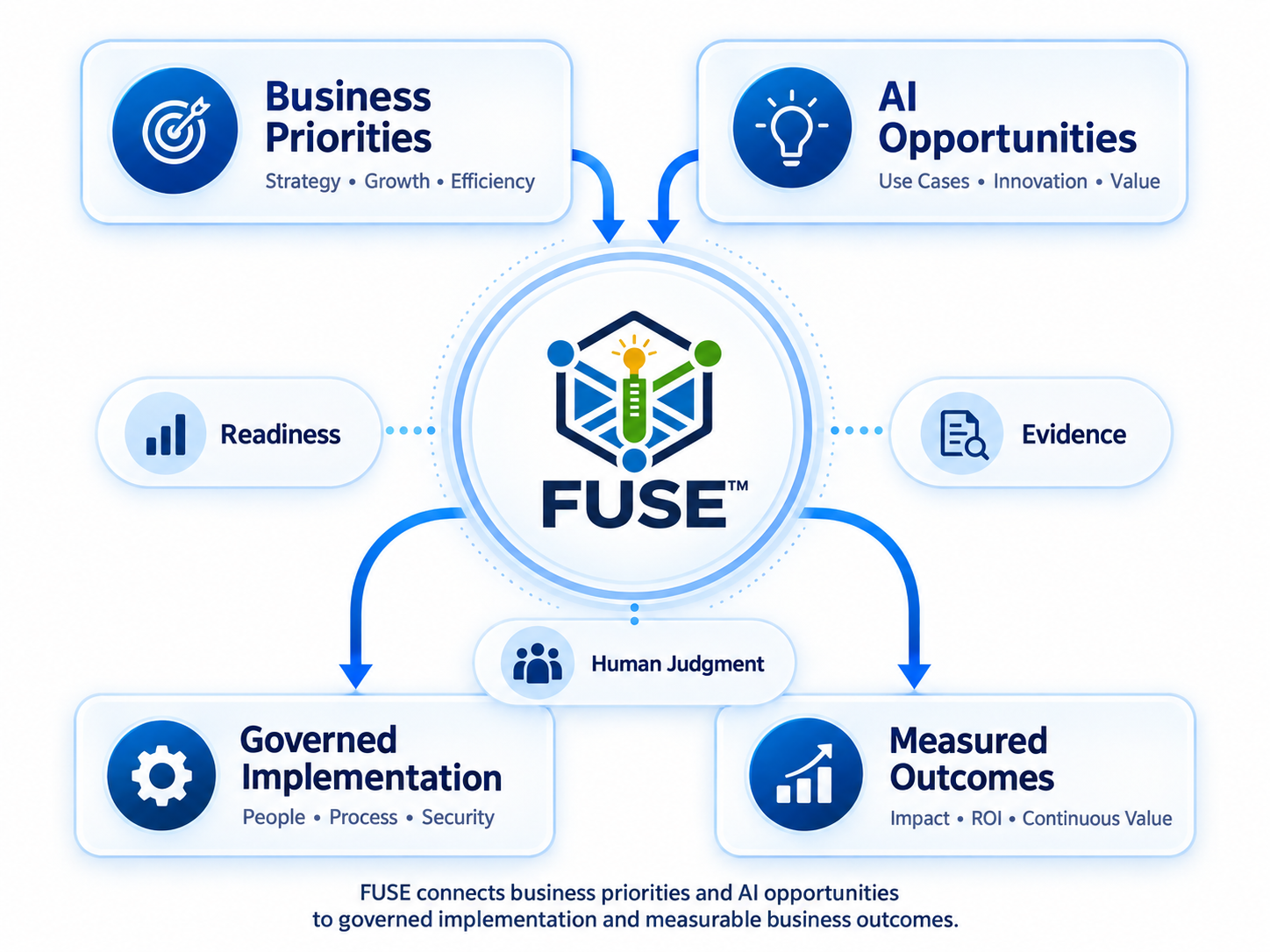
FUSE™ keeps readiness, human judgment, and evidence connected to the work as an initiative moves from opportunity into operation.

Diagram showing Business Priorities and AI Opportunities feeding into FUSE, which connects to Governed Implementation and Measured Outcomes, with Readiness, Human Judgment, and Evidence supporting the process.

What clients receive through FUSE™

FUSE™ work is designed to produce concrete, decision-ready artifacts rather than recommendations that disappear when a workshop ends.

Depending on the engagement and phase, structured outputs can include:

AssessmentsPrioritization matricesGovernance & risk registersRoadmapsDecision packagesImplementation plansKPI definitions & baselinesExecutive reportsDiagrams & analysesHandoff packagesDashboards & measurement outputs

The exact deliverables depend on the organization, initiative, and scope of work.

What makes FUSE™ different

How FUSE™ differs from generic AI consulting

Traditional consulting engagements can provide valuable expertise, analysis, and recommendations. The challenge arises when the methodology, evidence, decisions, and governance created during one stage do not carry cleanly into the next.

FUSE™ is designed around continuity. The same business priorities, use cases, governance requirements, ownership decisions, readiness conditions, and success measures established early in the lifecycle continue forward as implementation progresses.

Governance starts early

Risk, controls, security, and human oversight develop with the initiative rather than being added after the solution is built.

Evidence carries forward

Decisions, assumptions, measures, and deliverables remain connected as work progresses.

Technology and provider agnostic

FUSE™ does not require a specific AI vendor, platform, or model. Organizations can apply the framework with their approved AI technologies, including large language models, while preserving governance, flexibility, and future choice.

Value is measured

Business outcomes are evaluated against defined baselines and targets rather than relying only on qualitative statements of success.

Separation of duties stays explicit

Key review and approval responsibilities remain distinct. Preparers do not approve their own work, helping preserve accountability, independent review, and a clearer audit trail as initiatives move forward.

Reuse compounds

Skills, agents, controls, and KPI definitions can be reused across initiatives instead of recreated each time. That allows the organization to build on prior work and improve efficiency as AI adoption expands.

FUSE™ is designed for continuous improvement

The Evaluate and Evolve phase creates a feedback loop. What the organization learns from adoption, governance, performance, business outcomes, and operating experience informs the next set of priorities. AI adoption can mature over time instead of becoming a sequence of unrelated pilots.

Framework FAQs

What is the FUSE AI Framework?

The FUSE AI Framework is FUSEONai's structured methodology for moving AI from business priorities through governed implementation, measurable outcomes, and continuous improvement. It connects strategy, governance, data readiness, technology, adoption, and value measurement in a technology- and provider-agnostic way so AI initiatives can move from idea to operation without losing context or accountability.

Is FUSE™ a waterfall methodology?

No. FUSE™ uses four phases, but supporting workstreams such as governance, data readiness, security, change and adoption, and value measurement begin early and mature across the lifecycle. Work advances based on readiness and evidence rather than a rigid calendar sequence.

Where does AI governance fit within FUSE™?

Governance runs through every FUSE™ phase. Risk, controls, security, privacy, human oversight, ownership, and approval requirements are considered as the initiative develops rather than being added after a solution is built. This keeps governance connected to business and implementation decisions from the start.

Does FUSE™ require a specific AI platform or model?

No. FUSE™ is technology and provider agnostic. Organizations can apply the framework with their approved AI platforms, models, and tools, including large language models. The methodology focuses on business value, governance, readiness, implementation, and measurable outcomes rather than requiring a specific AI technology.

How does FUSE™ differ from a traditional AI consulting engagement?

Traditional consulting can provide valuable expertise and recommendations. FUSE™ is designed to preserve continuity across the lifecycle by carrying forward business priorities, use cases, governance requirements, ownership decisions, readiness conditions, evidence, success measures, and implementation decisions as work moves from strategy into execution and measurement.

Move from AI ambition to governed execution

Whether your organization is defining its first AI priorities or bringing structure to multiple initiatives already underway, FUSE™ provides a common method for connecting strategy, implementation, governance, and measurable value.

Start a Conversation